GOMEKLI (mirdametinib)

GOMEKLI (mirdametinib) dosing 
is designed for adults and children with NF1-PN

Actor portrayal.

GOMEKLI comes with a built-in treatment break

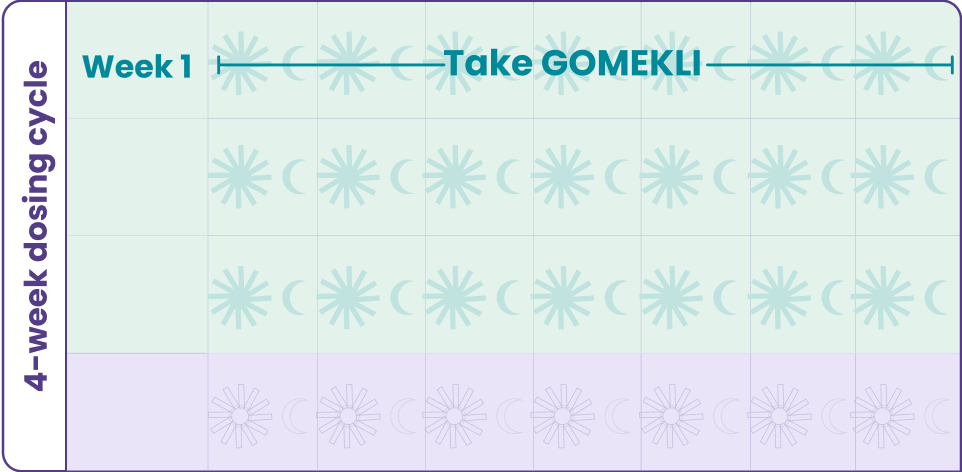
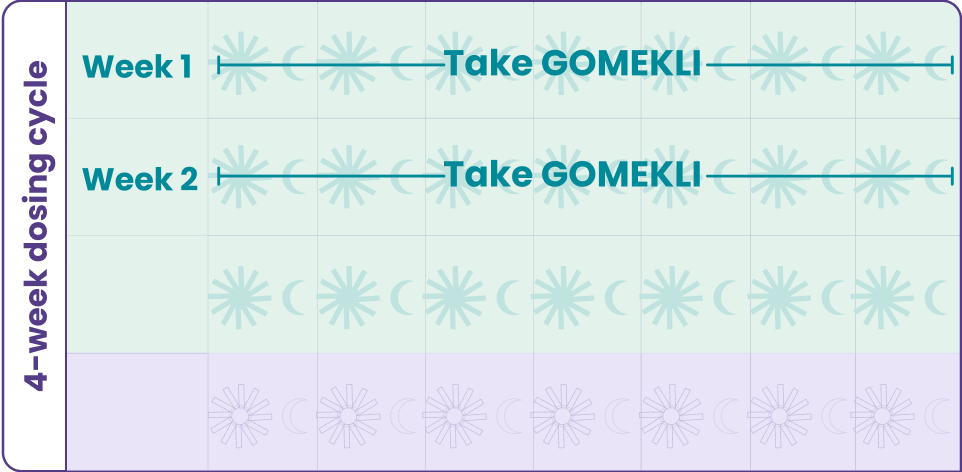
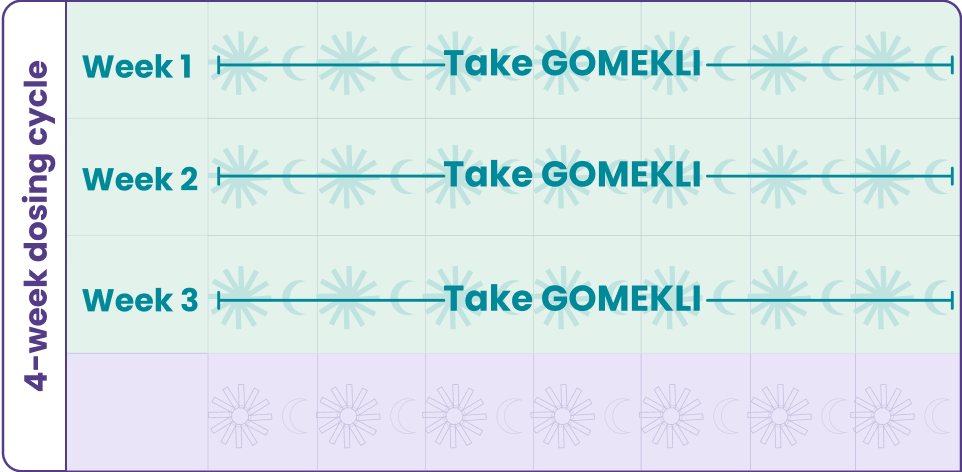
GOMEKLI is taken by mouth twice a day (about 12 hours apart).

Each GOMEKLI dosing cycle is 28 days (4 weeks).

GOMEKLI is taken for the first 21 days, followed by 7 days when GOMEKLI is not taken.

The next cycle then begins with 21 days of treatment.

Your healthcare provider will decide the right dose of GOMEKLI based on weight and height (body surface area). It’s important to take GOMEKLI as directed by your healthcare provider.

Setting up your GOMEKLI dosing calendar

Setting up your GOMEKLI dosing calendar

Learn how to keep track of GOMEKLI twice-daily dosing with an easy-to-use calendar.
Image onscreen:
Petal shape from GOMEKLI logo appears onscreen, spinning as if the video is loading. Petal shape comes to a stop as full GOMEKLI logo fades in.

Image onscreen:
GOMEKLI logo shrinks and moves to top center of the frame. Indication statement appears.

Text onscreen and voice-over:
GOMEKLI (mirdametinib) is a prescription medicine used to treat adults and children 2 years of age and older with neurofibromatosis type 1 (NF1) who have plexiform neurofibromas (PN) that cause symptoms and cannot be completely removed by surgery.

It is not known if GOMEKLI is safe and effective in children under 2 years of age.

Please see Important Safety Information later in this video and Patient Information available on GOMEKLI.com.

Image onscreen:
Screen fades and the video title appears. Flag with the logo in the top right corner of the frame appears, where it remains for the entirety of the video.

Text onscreen:
Setting up your GOMEKLI dosing calendar

Voice-over:
Today we’re going to talk about how to set up a GOMEKLI dosing calendar for you or the person you care for to help keep track of GOMEKLI twice-daily dosing.

Image onscreen:
A calendar with a month’s worth of days. The calendar animates to show specific dates.

Text onscreen:
GOMEKLI dosing calendar

Voice-over:
Let’s quickly review the GOMEKLI dosing schedule.

Text onscreen:
Twice-daily dosing, 12 hours apart

Image onscreen:
One by one, the days of the calendar are filled in with x’s for the first 21 days of the GOMEKLI cycle.

Text onscreen:
3 weeks of treatment followed by a treatment-free week

Voice-over:
GOMEKLI is taken by mouth twice a day, about 12 hours apart. Each GOMEKLI dosing cycle is 28 days. You take GOMEKLI for the first 21 days, and then for the last 7 days of the cycle, GOMEKLI is not taken. You can think of this as 3 weeks of treatment followed by a week-long treatment break.

Image onscreen:
The calendar begins to tilt, and the x’s disappear.

Text onscreen:
After the cycle ends, start over.

Image onscreen:
A hand holding a pen enters the frame. The date is filled in for the first day on the calendar, and then the corresponding sun icon is marked with an x. The rest of the dates appear.

Voice-over:
After the treatment-free week, you start over and the next cycle begins with 21 days of GOMEKLI treatment.

Image onscreen:
The SpringWorks CareConnections® logo.

Voice-over:
Once your doctor prescribes GOMEKLI, you can enroll in our free, personalized patient support program: SpringWorks CareConnections. They’ll send you a kit that includes a pillbox and calendar, which can be used to keep track of your dosing schedule.

Image onscreen:
A bag emblazoned with the GOMEKLI logo holds a pillbox and the dosing calendar. The patient starter kit disappears, and a kitchen scene appears. A man places the dosing calendar on a refrigerator.

Voice-over:
The calendar is a small magnetic dry-erase board that you can place on your refrigerator or another magnetic surface. Be sure to place the calendar somewhere visible so you never miss a dose.

Image onscreen:
The dosing calendar with a hand filling in the dates.

Text onscreen:
Start by filling out the dates.

Voice-over:
Using the dry-erase pen that comes with the board, fill in the boxes with the dates of your dosing cycle, including the 3 weeks of treatment as well as the treatment-free week, or 28 days total.

Image onscreen:
A man stands in front of his refrigerator holding a cup in one hand and a pill in the other.

Voice-over:
Each day, cross out the sun after taking or giving the morning dose of GOMEKLI.

Image onscreen:
The screen splits. On the left is the man; on the right is the dosing calendar. He takes the dose, and the sun gets crossed out.

Text onscreen:
Sun = morning dose

Voice-over:
Each day, cross out the sun after taking or giving the morning dose of GOMEKLI.

Image onscreen:
On the left is a close-up of a clock. Its hands rotate around the dial, starting and ending at 9 o'clock. On the right, there is a window; through it, the sky turns from day to night.

Text onscreen:
Moon = nighttime dose

Voice-over:
After taking or giving the nighttime dose, go back and cross out the moon.

Image onscreen:
The window is replaced with a close-up of the calendar. The moon gets crossed off. Then, the calendar fills the whole screen, and the mornings and nights of all the days of the month are crossed off.

Voice-over:
During the treatment-free week, keep marking off the days so you know when to start the next cycle. It’s that easy!

Image onscreen:
The man stands in front of his refrigerator erasing the dates from his GOMEKLI calendar.

Voice-over:
After the calendar is all filled in, you can just erase all the markings and begin adding dates for the next cycle.

Image onscreen:
A hand holding a bottle of GOMEKLI.

Voice-over:
It’s important to stay on track with GOMEKLI treatment and take or give the medication as directed by your doctor.

Image onscreen:
A close-up of the calendar; a pen circles the sun icon. The screen splits, and the man takes his next dose of GOMEKLI.

Voice-over:
If you miss a dose of GOMEKLI, skip the missed dose and take or give the next dose at your regularly scheduled time.

Image onscreen:
The man in his bathroom brushing his teeth.

Voice-over:
There are other ways to stay on track with GOMEKLI. You can pair it with another daily routine, for example, before or after brushing your teeth in the morning and at night.

Image onscreen:
The GOMEKLI pillbox. A case comes out of the box.

Text onscreen:
The pillbox has removable containers, so you can take GOMEKLI on the go.

Voice-over:
The pillbox included in the patient starter kit can also help you keep track of each dose. It includes 7 small containers, one for each day of the week. Each container has 2 compartments labeled AM and PM for your daytime and nighttime doses.

Image onscreen:
Two capsules, one on either side of an individual pill case. The capsules move into the case's individual compartments. The case closes and moves back into the pillbox.

Text onscreen:
Keep GOMEKLI and all medicines out of the reach of children.

Voice-over:
Fill the container with the appropriate amount of GOMEKLI capsules or tablets at the start of a treatment week. When the week is over and the box is empty, you can refill it and start over.

Image onscreen:
A mobile phone with a reminder alert on the screen.

Voice-over:
You can also set up dosing reminders on your phone using the GOMEKLI Digital Companion.

Image onscreen:
A phone screen showing the option to download the Medisafe app appears. Then the icons for Medisafe, Android, and Apple appear at right.

Voice-over:
The GOMEKLI Digital Companion is a free resource for people taking GOMEKLI, available on the Medisafe medication management app.

Image onscreen:
The man downloads the app and then uses it to set up a medication reminder.

Voice-over:
After downloading the Medisafe app and creating a profile, you can set up your GOMEKLI dosing calendar and add medication reminders so you never miss a dose.

Image onscreen:
The animation zooms out. The man holds his phone as he continues to configure the app.

Text onscreen:
Be sure to inform your doctor about all the medicines you take, including prescription and over-the-counter medicines, vitamins, and herbal supplements.

Voice-over:
You can track all your medications, vitamins, and supplements with Medisafe, as well as set up refill reminders and reminders for doctor’s appointments.

Image onscreen:
A phone screen in close-up shows the support page from GOMEKLI.com.

Voice-over:
You can learn more about the GOMEKLI Digital Companion at GOMEKLI.com.

Image onscreen:
The man in his kitchen, standing at his counter drinking a cup of coffee, looks at the GOMEKLI dosing calendar.

Voice-over:
Good luck setting up your GOMEKLI dosing calendar. Feel free to rewatch this video at any time and explore additional resources at GOMEKLI.com.

Text onscreen and voice-over:
Important Safety Information
Before taking GOMEKLI, tell your healthcare provider about all of your medical conditions, including if you:
  • Have eye problems
  • Have heart problems
  • Are pregnant or plan to become pregnant. GOMEKLI can harm your unborn baby
  • Females who are able to become pregnant:
    • Your healthcare provider should check to see if you are pregnant before you begin treatment with GOMEKLI.
    • Use effective birth control (contraception) during treatment with GOMEKLI and for 6 weeks after your last dose.
    • Tell your healthcare provider right away if you become pregnant or think you may be pregnant during treatment with GOMEKLI.
  • Males with female partners who are able to become pregnant:
    • Use effective birth control (contraception) during treatment with GOMEKLI and for 3 months after your last dose.
    • Tell your healthcare provider right away if your female partner becomes pregnant or thinks she may be pregnant during treatment with GOMEKLI.
  • Are breastfeeding or plan to breastfeed. It is not known if GOMEKLI passes into your breastmilk.
    • Do not breastfeed during treatment with GOMEKLI and for 1 week after your last dose.
    • Talk to your healthcare provider about the best way to feed your baby during this time.
Tell your healthcare provider about all the medicines you take, including prescription and over-the-counter medicines, vitamins, and herbal supplements.

How should I take GOMEKLI?
  • Take GOMEKLI exactly as your healthcare provider tells you to take it. Your healthcare provider may change your dose, temporarily stop, or permanently stop treatment with GOMEKLI if you develop certain side effects.
  • Take GOMEKLI twice a day, about 12 hours apart, for 21 days, followed by 7 days off treatment, to complete a 28-day treatment cycle. Your healthcare provider will decide how many treatment cycles are right for you.
  • Take GOMEKLI with or without food.
  • GOMEKLI comes in two different dosage forms, GOMEKLI capsules and GOMEKLI tablets for oral suspension. Your healthcare provider will decide the dosage form and dose of GOMEKLI that is right for you.
  • If you take GOMEKLI capsules: Swallow each capsule whole with drinking water. If more than 1 capsule is required, swallow 1 capsule at a time. Do not open, break or chew the capsules.
  • If you take GOMEKLI tablets for oral suspension, either:
    • Swallow each tablet for oral suspension whole with drinking water. If more than 1 tablet is required, swallow 1 tablet at a time.
    • OR
    • Disperse the tablets for oral suspension in drinking water to make a liquid (suspension) before you take or give GOMEKLI.
  • See the “Instructions for Use” that come with your medicine for instructions on how to prepare and take GOMEKLI tablets for oral suspension.
  • If you miss a dose of GOMEKLI, skip the missed dose and take your next dose at your regularly scheduled time.
  • If you vomit at any time after taking GOMEKLI, do not take an additional dose. Take your next dose at your regularly scheduled time.

What are the possible side effects of GOMEKLI?
GOMEKLI may cause serious side effects, including:
  • Eye problems. GOMEKLI may cause eye problems that can lead to blindness. Your healthcare provider will check your vision before and during treatment with GOMEKLI. Tell your healthcare provider right away if you get any of the following signs or symptoms of eye problems:
    • Blurred vision
    • Loss of vision
    • Other changes to your vision
  • Heart problems. GOMEKLI may lower the amount of blood pumped by your heart, which is common in children during treatment with GOMEKLI and can also be severe. Your healthcare provider will do tests before you start GOMEKLI treatment, every 3 months during your first year of treatment, and then as needed to make sure your heart is working properly. Tell your healthcare provider right away if you get any of the following signs or symptoms of heart problems:
    • Coughing or wheezing
    • Shortness of breath
    • Swelling of your ankles and feet
    • Tiredness
    • Increased heart rate
  • Skin problems. Skin rashes are common with GOMEKLI in both adults and children and can also be severe. GOMEKLI can also cause hair loss (alopecia). Tell your healthcare provider if you develop any of the following signs or symptoms of skin problems:
    • Flat skin rash
    • Raised bumps on the skin
    • Skin bumps that look like acne
    • Skin redness
    • Itchy rash
    • Peeling skin

The most common side effects of GOMEKLI in adults include:
    • Diarrhea
    • Nausea
    • Muscle, joint, and bone pain
    • Vomiting
    • Tiredness
The most common severe abnormal blood tests in adults include an increased enzyme called creatine phosphokinase (CPK).

The most common side effects of GOMEKLI in children include:
    • Diarrhea
    • Muscle, joint, and bone pain
    • Stomach (abdominal) pain
    • Vomiting
    • Headache
    • Skin redness, swelling, or pain around the fingernails or toenails
    • Nausea
The most common severe abnormal blood tests in children include decreased white blood cell (neutrophil) counts and increased CPK.

GOMEKLI may cause fertility problems in females, which may affect your ability to have children. Talk to your healthcare provider if you have concerns about fertility.

These are not all of the possible side effects of GOMEKLI. Call your doctor for medical advice about side effects. You may report side effects to FDA at 1-800-FDA-1088.

Please see full Prescribing Information, including Patient Information and Instructions for Use, available on GOMEKLI.com.

Text onscreen:
Thank you!

©2025 SpringWorks Therapeutics, Inc. All rights reserved. GOMEKLI and SpringWorks CareConnections are registered trademarks of SpringWorks Therapeutics, Inc. All other trademarks and logos are the property of their respective owners. C_GOM_US_0433 8/25

Voice-over:
Thank you for watching.
Learn how to keep track of GOMEKLI twice-daily dosing with an easy-to-use calendar.

Staying on track with treatment

Support is always within reach! When you download the FREE Medisafe app, you can use the GOMEKLI Digital Companion to set up customized medication reminders.
Learn more about this free resource, or scan the QR code to download Medisafe and get started.
Learn more about this free resource, or download the Medisafe app to get started.
Google Play Download Logo
Apple App Store Download Logo

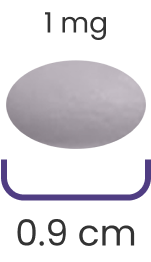
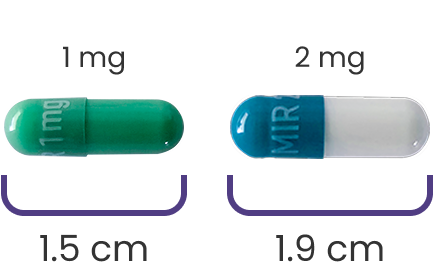
GOMEKLI comes in 2 forms

Grape-flavored tablets

for oral suspension
Capsules that come in

2 sizes

Tic Tac® and its three-dimensional design are registered trademarks of Ferrero S.A.

Oral suspension means the tablets mix or disperse into water, so the medicine can be taken as a liquid. This may make taking GOMEKLI easier for people who have difficulty swallowing. Tablets can also be swallowed whole.

Dispersing GOMEKLI tablets

Dispersing GOMEKLI tablets

View a step-by-step guide on how to prepare and then take or administer GOMEKLI as a liquid.

Image onscreen:
Petal shape from GOMEKLI logo appears onscreen, spinning as if the video is loading. Petal shape comes to a stop as full GOMEKLI logo fades in.

Image onscreen:
GOMEKLI logo shrinks and moves to top center of the frame. Indication statement appears.

Text onscreen and voice-over:
GOMEKLI (mirdametinib) is a prescription medicine used to treat adults and children 2 years of age and older with neurofibromatosis type 1 (NF1) who have plexiform neurofibromas (PN) that cause symptoms and cannot be completely removed by surgery.

It is not known if GOMEKLI is safe and effective in children under 2 years of age.

Please see Important Safety Information later in this video and Patient Information available on GOMEKLI.com.

Text onscreen:
Dispersing GOMEKLI tablets for oral suspension

Voice-over:
In this video, we’ll explain what you need to know about preparing and taking GOMEKLI as a liquid. Remember, your healthcare provider is your primary source for information on GOMEKLI.

Image onscreen:
A GOMEKLI tablet and two capsules appear onscreen. The capsules disappear, leaving only the tablet in view.

Text onscreen (under the corresponding images):
Capsules in 2 sizes
Tablets fororal suspension

Voice-over:
GOMEKLI is available in 2 forms: capsules that come in 2 sizes and tablets for oral suspension.

Image onscreen:
A GOMEKLI tablet is placed in a dosing cup filled with water. The mixture is swirled around and the liquid, now cloudy and white, settles.

Text onscreen:
Oral suspension means the tablets can mix into water.

Voice-over:
Oral suspension means the tablets mix or disperse into water, so the medicine can be taken as a liquid. This may make taking GOMEKLI easier for people who have difficulty swallowing. Follow along as we show you how to prepare GOMEKLI.

Image onscreen:
A man takes a GOMEKLI tablet with a sip of water.

Text onscreen:
GOMEKLI can be taken with or without food.

Voice-over:
The tablets can also be swallowed whole.

Image onscreen:
We see a man from behind as he reviews his GOMEKLI dosing calendar. As the voice-over plays, the sun symbols are bolded and the words “Treatment-free week” appear at the bottom of the calendar.

Text onscreen:
Take GOMEKLI by mouth twice daily for 21 days. Then, take 7 days off before resuming treatment.

Voice-over:
GOMEKLI is taken by mouth twice a day, about 12 hours apart. Each GOMEKLI dosing cycle is 28 days. You take GOMEKLI for the first 21 days, followed by a 7-day treatment break. The next cycle then begins with another 21 days of treatment.

Image onscreen:
The patient and his doctor are shown talking in the doctor’s office.

Text onscreen:
It’s important to take GOMEKLI as directed by your healthcare provider.

Voice-over:
Your healthcare provider will decide the dosage form and dose of GOMEKLI that is right for you. The following instructions are only for those who have been prescribed GOMEKLI tablets and plan to take the medicine as a liquid.

Image onscreen:
Instructions for taking GOMEKLI as a liquid are shown onscreen. As the narrator reads out each bullet point, its corresponding animated icon appears.

Text onscreen and voice-over:
Here’s what you’ll need in order to take GOMEKLI as a liquid:
  • The prescribed number of GOMEKLI tablets
  • A dosing cup provided by your healthcare provider or pharmacist
  • About 10 to 20 milliliters of drinking water
  • A 10 milliliter oral syringe, if you’re using one, provided by your healthcare provider or pharmacist
GOMEKLI can be taken as a liquid using either a dosing cup or an oral syringe.

Image onscreen:
A man is shown with his supplies laid out in preparation to take GOMEKLI as a liquid.

Text onscreen:
You’re ready to GO!

Voice-over:
If you have everything that you need, it’s time to prepare GOMEKLI tablets for oral suspension.

Image onscreen:
Hands being washed in a sink and then dried.

Text onscreen:
Wash and dry your hands.

Voice-over:
Make sure your hands are clean. Wash and dry them before preparing GOMEKLI.

Image onscreen:
A dosing cup being filled with water at the sink.

Text onscreen:
Add 5 to 10 mL of water to the cup.

Voice-over:
Take the dosing cup and add 5 to 10 milliliters of drinking water to it. The amount of water doesn’t have to be exact, but be sure to only use water.

Image onscreen:
A close-up of a patient’s open hand holding two tablets.

Text onscreen:
It’s important to take GOMEKLI exactly as your doctor prescribed.

Voice-over:
Get the number of GOMEKLI tablets that your healthcare provider prescribed. Remember, it’s important to take GOMEKLI exactly as your healthcare provider told you to.

Image onscreen:
The patient drops the tablets into the dosing cup.

Text onscreen:
Add the tablets to the dosing cup.

Voice-over:
Add the prescribed number of tablets to the dosing cup.

Image onscreen:
The patient picks up the cup and swirls it around. As the tablets are dissolved into the water, it turns into a white and cloudy liquid.

Text onscreen:
Swirl the cup gently until the liquid is white and cloudy.

Voice-over:
Gently swirl the dosing cup dispersing the tablets until there aren’t any more lumps. This will take about 2 to 4 minutes. At this point, the medicine will look white and cloudy.

Image onscreen:
A hand uses a paper towel to clean up spilled GOMEKLI. Then a split screen appears: A patient washes their hands on the left side and a garbage can is shown on the right side.

Text onscreen:
Use a paper towel to clean up spilled GOMEKLI. Wash your hands afterward.

Voice-over:
Try not to spill any of the medicine during this step. If you do, use a paper towel to soak up the spilled liquid, and throw it away. Make sure to wash your hands with soap and water after throwing the paper towel away.

Image onscreen:
The patient is shown taking GOMEKLI with the dosing cup, and then the screen transitions to an image of a 30-minute timer. Finally, the shot changes to a split screen, with a timer on the left and a garbage can on the right.

Text onscreen:
Take GOMEKLI within 30 minutes of preparing it.

Voice-over:
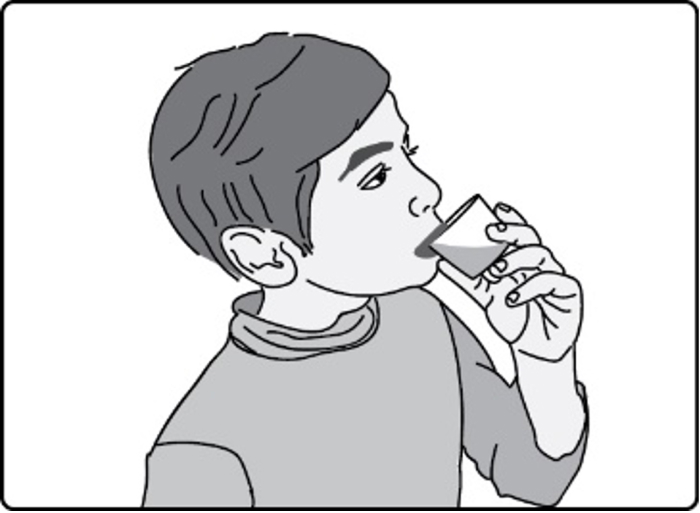
If you’re using the dosing cup rather than a syringe to take GOMEKLI, the medicine is ready to take. Drink the GOMEKLI solution from the dosing cup right away, waiting no more than 30 minutes after preparing it. If more than 30 minutes pass, throw out the solution and start over.

Image onscreen:
The patient places the tip of the syringe into the dosing cup, the plunger is pulled back, and the liquid is transferred from the cup into the syringe.

Text onscreen:
Taking or giving GOMEKLI from an oral syringe: Draw the liquid from the dosing cup into the syringe.

Voice-over:
If you’re using an oral syringe to give the medication, place the tip of the syringe into the dosing cup, and draw up all the liquid by pulling back on the plunger.

Image onscreen:
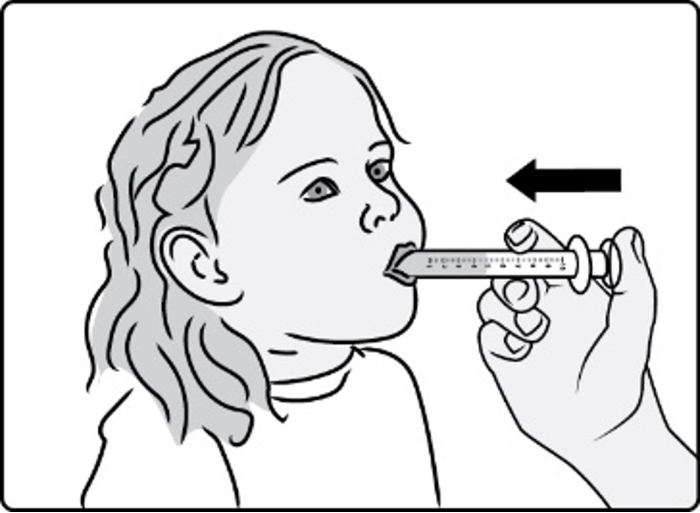
The screen shows a close-up of a child being administered a dose of GOMEKLI with a syringe.

Text onscreen:
Place the tip of the syringe inside the mouth and slowly push the plunger down.

Voice-over:
Place the tip of the syringe inside the mouth, pointed toward the inside of either cheek. Slowly push the plunger all the way down to give the full dose of GOMEKLI and allow time for the medicine to be swallowed.

Image onscreen:
The screen shows the parent holding the syringe and the child sitting upright, waiting to receive the dose of medication.

Text onscreen:
Make sure children sit upright until they completely swallow GOMEKLI.

Voice-over:
If you’re giving GOMEKLI to a child, make sure he or she is sitting upright until all the liquid has been swallowed.

Image onscreen:
A dosing cup with residual GOMEKLI mixture is shown on the left, and a syringe with residual GOMEKLI mixture is shown on the right.

Text onscreen:
After you take the GOMEKLI mixture, there will be some left in the dosing cup.

Voice-over:
Whether you take GOMEKLI straight from the dosing cup or with the oral syringe, there will still be some medicine left in the cup afterward, even if it’s hard to see.

Image onscreen:
Person adds water to the dosing cup.

Text onscreen:
Add 5 to 10 milliliters (mL) of water to the dosing cup.

Voice-over:
To make sure that you take the entire dose, add another 5 to 10 milliliters of drinking water to the same dosing cup.

Image onscreen:
The screen splits, showing an adult patient on the left side dissolving the tablet in the dosing cup and drinking it, and a child patient on the right side having the GOMEKLI treatment administered to them with a syringe.

Text onscreen:
Follow the same steps as before to complete your dose.

Voice-over:
Gently swirl the dosing cup again and drink the mixture. If you’re using a syringe, draw the solution from the dosing cup. Place the tip of the syringe into the mouth again, and slowly push the plunger all the way down.

Image onscreen:
Person washing the dosing cup, and their hands, in a sink.

Text onscreen:
Wash and dry the dosing cup before storing it. Wash your hands when you’re done.

Voice-over:
When you’re finished, wash out the dosing cup with clean water, allowing it to dry before storing it. Wash your hands with soap when you’re done.

Image onscreen:
The screen first shows a GOMEKLI bottle placed in a cabinet with a green check mark drawn over it. Then the shot transitions into a split screen, with the first image sliding over to the left and a new image (of a GOMEKLI bottle on a windowsill in direct sunlight) appearing on the right. The image on the right has a red X placed over it, and the image on the left has a green check mark placed over it.

Text onscreen:
Store GOMEKLI at room temperature and away from light.

Voice-over:
GOMEKLI tablets should be stored at room temperature between 68 and 77 degrees Fahrenheit (or 20 and 25 degrees Celsius). Protect GOMEKLI from light.

Image onscreen:
The screen transitions to an animation of a woman’s hand holding the GOMEKLI pill bottle. The shot then widens to reveal a fuller image of the woman as she places the bottle down on the counter.

Text onscreen:
Talk to your healthcare provider or pharmacist if you have any questions.

Voice-over:
Now you know how to prepare GOMEKLI tablets for oral suspension. If you have any questions about…

Image onscreen:
Cut to a scene of a patient and his doctor in conversation at the doctor’s office.

Voice-over:
…how to prepare and take or give a dose of GOMEKLI tablets for oral suspension, talk to your healthcare provider or pharmacist. You can also rewatch this video at any time or read the GOMEKLI Instructions for Use.

Text onscreen and voice-over:
Important Safety Information
Before taking GOMEKLI, tell your healthcare provider about all of your medical conditions, including if you:
  • Have eye problems
  • Have heart problems
  • Are pregnant or plan to become pregnant. GOMEKLI can harm your unborn baby
    Females who are able to become pregnant:
    • Your healthcare provider should check to see if you are pregnant before you begin treatment with GOMEKLI.
    • Use effective birth control (contraception) during treatment with GOMEKLI and for 6 weeks after your last dose.
    • Tell your healthcare provider right away if you become pregnant or think you may be pregnant during treatment with GOMEKLI.
    • Males with female partners who are able to become pregnant:
    • Use effective birth control (contraception) during treatment with GOMEKLI and for 3 months after your last dose.
    • Tell your healthcare provider right away if your female partner becomes pregnant or thinks she may be pregnant during treatment with GOMEKLI.
  • Are breastfeeding or plan to breastfeed. It is not known if GOMEKLI passes into your breastmilk.
    • Do not breastfeed during treatment with GOMEKLI and for 1 week after your last dose.
    • Talk to your healthcare provider about the best way to feed your baby during this time.
  • Tell your healthcare provider about all the medicines you take, including prescription and over-the-counter medicines, vitamins, and herbal supplements.

How should I take GOMEKLI?
  • Take GOMEKLI exactly as your healthcare provider tells you to take it. Your healthcare provider may change your dose, temporarily stop, or permanently stop treatment with GOMEKLI if you develop certain side effects.
  • Take GOMEKLI twice a day, about 12 hours apart, for 21 days, followed by 7 days off treatment, to complete a 28-day treatment cycle. Your healthcare provider will decide how many treatment cycles are right for you.
  • Take GOMEKLI with or without food.
  • GOMEKLI comes in two different dosage forms, GOMEKLI capsules and GOMEKLI tablets for oral suspension. Your healthcare provider will decide the dosage form and dose of GOMEKLI that is right for you.
  • If you take GOMEKLI capsules: Swallow each capsule whole with drinking water. If more than 1 capsule is required, swallow 1 capsule at a time. Do not open, break or chew the capsules.
  • If you take GOMEKLI tablets for oral suspension, either:
    • Swallow each tablet for oral suspension whole with drinking water. If more than 1 tablet is required, swallow 1 tablet at a time.
    • OR
    • Disperse the tablets for oral suspension in drinking water to make a liquid (suspension) before you take or give GOMEKLI.
  • See the “Instructions for Use” that come with your medicine for instructions on how to prepare and take GOMEKLI tablets for oral suspension.
  • If you miss a dose of GOMEKLI, skip the missed dose and take your next dose at your regularly scheduled time.
  • If you vomit at any time after taking GOMEKLI, do not take an additional dose. Take your next dose at your regularly scheduled time.

What are the possible side effects of GOMEKLI?
GOMEKLI may cause serious side effects, including:
  • Eye problems. GOMEKLI may cause eye problems that can lead to blindness. Your healthcare provider will check your vision before and during treatment with GOMEKLI. Tell your healthcare provider right away if you get any of the following signs or symptoms of eye problems:
    • Blurred vision
    • Loss of vision
    • Other changes to your vision
  • Heart problems. GOMEKLI may lower the amount of blood pumped by your heart, which is common in children during treatment with GOMEKLI and can also be severe. Your healthcare provider will do tests before you start GOMEKLI treatment, every 3 months during your first year of treatment, and then as needed to make sure your heart is working properly. Tell your healthcare provider right away if you get any of the following signs or symptoms of heart problems:
    • Coughing or wheezing
    • Shortness of breath
    • Swelling of your ankles and feet
    • Tiredness
    • Increased heart rate
  • Skin problems. Skin rashes are common with GOMEKLI in both adults and children and can also be severe. GOMEKLI can also cause hair loss (alopecia). Tell your healthcare provider if you develop any of the following signs or symptoms of skin problems:
    • Flat skin rash
    • Raised bumps on the skin
    • Skin bumps that look like acne
    • Skin redness
    • Itchy rash
    • Peeling skin

The most common side effects of GOMEKLI in adults include:
  • Diarrhea
  • Nausea
  • Muscle, joint, and bone pain
  • Vomiting
  • Tiredness
The most common severe abnormal blood tests in adults include an increased enzyme called creatine phosphokinase (CPK).

The most common side effects of GOMEKLI in children include:
  • Diarrhea
  • Muscle, joint, and bone pain
  • Stomach (abdominal) pain
  • Vomiting
  • Headache
  • Skin redness, swelling, or pain around the fingernails or toenails
  • Nausea

The most common severe abnormal blood tests in children include decreased white blood cell (neutrophil) counts and increased CPK.

GOMEKLI may cause fertility problems in females, which may affect your ability to have children. Talk to your healthcare provider if you have concerns about fertility.

These are not all of the possible side effects of GOMEKLI. Call your doctor for medical advice about side effects. You may report side effects to FDA at 1-800-FDA-1088.

Please see full Prescribing Information, including Patient Information and Instructions for Use, available on GOMEKLI.com.

Text onscreen:
Thank you!

©2025 SpringWorks Therapeutics, Inc. All rights reserved. GOMEKLI is a registered trademark of SpringWorks Therapeutics, Inc. C_GOM_US_0431 8/25

Voice-over:
Thank you for watching.
View a step-by-step guide on how to prepare and then take or administer GOMEKLI as a liquid.

Preparing GOMEKLI tablets for liquid dosing

OR

GOMEKLI can be taken with or without food: No fasting is required

Getting started guide

A brochure that has what you need and want to know about taking GOMEKLI.


Personalized treatment journal

A tool that helps you keep track of your experience with GOMEKLI to share with your care team.

Before starting GOMEKLI treatment

Your healthcare provider may order some tests before and during GOMEKLI treatment, including:

Echocardiogram

to look at the heart

Blood tests

Eye exam

to check your vision and the health of your eyes

Pregnancy test

for people who are able to become pregnant

Watch this video to learn more about the tests you may need before and during GOMEKLI treatment.

Before taking GOMEKLI, tell your healthcare provider about all of your medical conditions.

SpringWorks CareConnections® logo

Savings and support

SpringWorks CareConnections offers support and resources for people taking GOMEKLI.

NF1-PN=neurofibromatosis type 1 with plexiform neurofibromas.

What is GOMEKLI?

GOMEKLI (mirdametinib) is a prescription medicine used to treat adults and children 2 years of age and older with neurofibromatosis type 1 (NF1) who have plexiform neurofibromas (PN) that cause symptoms and cannot be completely removed by surgery.

It is not known if GOMEKLI is safe and effective in children under 2 years of age.

Important Safety Information

Before taking GOMEKLI, tell your healthcare provider about all of your medical conditions, including if you:

  • Have eye problems
  • Have heart problems
  • Are pregnant or plan to become pregnant. GOMEKLI can harm your unborn baby

    Females who are able to become pregnant:

    • Your healthcare provider should check to see if you are pregnant before you begin treatment with GOMEKLI.
    • Use effective birth control (contraception) during treatment with GOMEKLI and for 6 weeks after your last dose.
    • Tell your healthcare provider right away if you become pregnant or think you may be pregnant during treatment with GOMEKLI.

    Males with female partners who are able to become pregnant:

    • Use effective birth control (contraception) during treatment with GOMEKLI and for 3 months after your last dose.
    • Tell your healthcare provider right away if your female partner becomes pregnant or thinks she may be pregnant during treatment with GOMEKLI.
  • Are breastfeeding or plan to breastfeed. It is not known if GOMEKLI passes into your breastmilk.
    • Do not breastfeed during treatment with GOMEKLI and for 1 week after your last dose.
    • Talk to your healthcare provider about the best way to feed your baby during this time.

Tell your healthcare provider about all the medicines you take, including prescription and over-the-counter medicines, vitamins, and herbal supplements.

How should I take GOMEKLI?

  • Take GOMEKLI exactly as your healthcare provider tells you to take it. Your healthcare provider may change your dose, temporarily stop, or permanently stop treatment with GOMEKLI if you develop certain side effects.
  • Take GOMEKLI twice a day, about 12 hours apart, for 21 days, followed by 7 days off treatment, to complete a 28-day treatment cycle. Your healthcare provider will decide how many treatment cycles are right for you.
  • Take GOMEKLI with or without food.
  • GOMEKLI comes in two different dosage forms, GOMEKLI capsules and GOMEKLI tablets for oral suspension. Your healthcare provider will decide the dosage form and dose of GOMEKLI that is right for you.
  • If you take GOMEKLI capsules: Swallow each capsule whole with drinking water. If more than 1 capsule is required, swallow 1 capsule at a time. Do not open, break or chew the capsules.
  • If you take GOMEKLI tablets for oral suspension, either:
    • Swallow each tablet for oral suspension whole with drinking water. If more than 1 tablet is required, swallow 1 tablet at a time.
    • OR

    • Disperse the tablets for oral suspension in drinking water to make a liquid (suspension) before you take or give GOMEKLI.

    See the “Instructions for Use” that come with your medicine for instructions on how to prepare and take GOMEKLI tablets for oral suspension.

  • If you miss a dose of GOMEKLI, skip the missed dose and take your next dose at your regularly scheduled time.
  • If you vomit at any time after taking GOMEKLI, do not take an additional dose. Take your next dose at your regularly scheduled time.

What are the possible side effects of GOMEKLI?

GOMEKLI may cause serious side effects, including:
  • Eye problems. GOMEKLI may cause eye problems that can lead to blindness. Your healthcare provider will check your vision before and during treatment with GOMEKLI. Tell your healthcare provider right away if you get any of the following signs or symptoms of eye problems:
    • Blurred vision
    • Loss of vision
    • Other changes to your vision
  • Heart problems. GOMEKLI may lower the amount of blood pumped by your heart, which is common in children during treatment with GOMEKLI and can also be severe. Your healthcare provider will do tests before you start GOMEKLI treatment, every 3 months during your first year of treatment, and then as needed to make sure your heart is working properly. Tell your healthcare provider right away if you get any of the following signs or symptoms of heart problems:
    • Coughing or wheezing
    • Shortness of breath
    • Swelling of your ankles and feet
    • Tiredness
    • Increased heart rate
  • Skin problems. Skin rashes are common with GOMEKLI in both adults and children and can also be severe. GOMEKLI can also cause hair loss (alopecia). Tell your healthcare provider if you develop any of the following signs or symptoms of skin problems:
    • Flat skin rash
    • Raised bumps on the skin
    • Skin bumps that look like acne
    • Skin redness
    • Itchy rash
    • Peeling skin

The most common side effects of GOMEKLI in adults include:

  • Diarrhea
  • Nausea
  • Muscle, joint, and bone pain
  • Vomiting
  • Tiredness
The most common severe abnormal blood tests in adults include an increased enzyme called creatine phosphokinase (CPK).

The most common side effects of GOMEKLI in children include:

  • Diarrhea
  • Muscle, joint, and bone pain
  • Stomach (abdominal) pain
  • Vomiting
  • Headache
  • Skin redness, swelling, or pain around the fingernails or toenails
  • Nausea
The most common severe abnormal blood tests in children include decreased white blood cell (neutrophil) counts and increased CPK.
GOMEKLI may cause fertility problems in females, which may affect your ability to have children. Talk to your healthcare provider if you have concerns about fertility.
These are not all of the possible side effects of GOMEKLI. Call your doctor for medical advice about side effects. You may report side effects to FDA at 1-800-FDA-1088.

What is GOMEKLI?

GOMEKLI (mirdametinib) is a prescription medicine used to treat adults and children 2 years of age and older with neurofibromatosis type 1 (NF1) who have plexiform neurofibromas (PN) that cause symptoms and cannot be completely removed by surgery.

It is not known if GOMEKLI is safe and effective in children under 2 years of age.

Please click here for full Prescribing Information, including Patient Information and Instructions for Use.